



Yamaha Exhaust Headers & Link Pipes

What's actually on this shelf
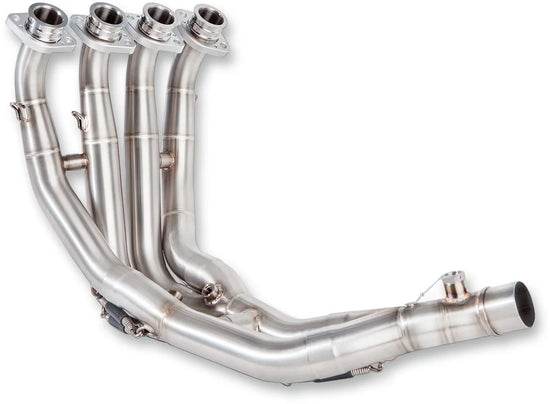
144 listings from Akrapovic and LeoVince sit here, covering 18 marques. Our own titles split them several ways, and a single product often carries more than one of these words at once: 59 say Header or Headpipe, 48 say Link Pipe, 31 say Collector, and 5 say Mid Pipe. A header sold with its own collector, for instance, counts under both.
- Header, headpipe, downpipe
- the pipe bolted straight to the cylinder head. Our own titles say header or headpipe. Riders on the forums we read call the same part a downpipe just as often.
- Collector, Y-pipe
- where two or more header pipes merge into one, on a multi-cylinder engine. Some titles on this shelf call it a Y-pipe instead.
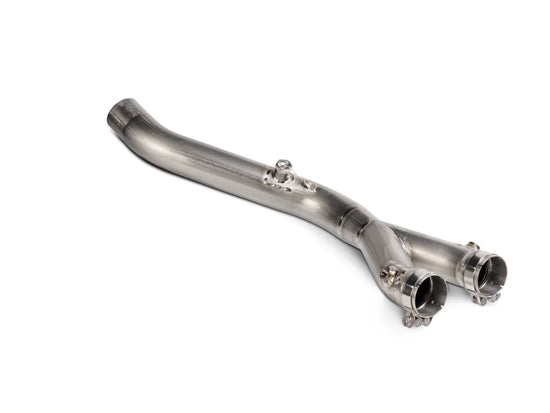
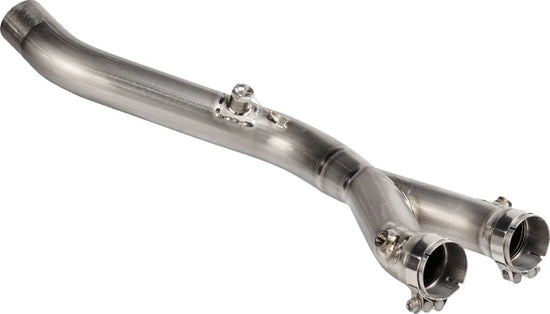
- Link pipe, mid pipe
- the section that carries on from the collector to the end can. Our own titles use both names for what reads as the same kind of part.
A smaller group on this shelf says something about the catalytic converter directly, and it splits both ways. Four are titled CAT Eliminator, a link pipe built to remove the cat. Eleven, mostly for scooters, go the other way: a Catalytic Converter Manifold is a replacement header that keeps a cat fitted rather than deleting one. Both exist on this shelf. Which one you need is in the listing, not something to guess from the shelf as a whole. That title is not always the whole story either: LeoVince's own datasheets for two of our shelf's Link Pipe listings, the Yamaha MT-10 (8099) and the Yamaha YZF-R1 (8088), each describe the part as a cat eliminator in their own words, even though neither of our titles says CAT. Check the specific listing for a cat-related part rather than assuming the title covers it.
The pipe that has to match, not just the bike
A link pipe is defined by what it joins, not by the bike alone. One rider fitting a used slip-on can to a Suzuki SV650 found it needed a 54mm link pipe. A different brand's cans for the same model used pipes closer to 50mm or 51mm. The bike had not changed. The can had.
One UK exhaust maker has explained why this keeps happening. A brand often reuses the same end can across several models and only swaps the link pipe to match each one. The can stays standard. The pipe absorbs the difference. Buy a link pipe from a different source than the can it has to meet, and there is a real chance the two were never built for each other.
What a header swap can take with it
On an older water-cooled BMW GS, the exhaust valve turned out to live inside the catalytic converter housing itself, not somewhere downstream of it. Riders fitting an aftermarket header removed the valve at the same time as the cat, without planning to. One rider reported the fuelling running lean afterwards on the standard mapping, and needed a dyno remap to correct it. That generation has since moved on, and none of this is a claim about a current fitment. The question is worth asking on any bike before a header comes off. Check what else is built into the part you are removing, not just whether the new pipe fits.
Does fitting a header or link pipe need an ECU remap?
Whether fitting a header or link pipe requires an ECU remap is not one instruction; the manufacturers word it differently part to part. Akrapovic say "ECU remapping is mandatory" for its Honda Fireblade header (E-H10E2) and its Yamaha MT-10 link pipe (L-Y10SO19/2). For its BMW S1000RR header (E-B10E8), the wording softens to "remapping is recommended". LeoVince's own datasheet for its Ducati Multistrada CAT Eliminator link pipe (80036) is softer again: it advises remapping the stock ECU, or fitting an additional ECU unit, to get the fuelling right. Which wording applies is on the listing for that part, not something to assume from the brand.
Akrapovic's own datasheet for its Kawasaki ZX-10R link pipe (L-K10SO9) names a further part some buyers miss: "the optional noise insert should be used when the Slip-On Line (Titanium) and optional link-pipe are used in conjunction with each other," an extra piece needed for that specific titanium can and link pipe combination, not supplied with either by default.
LeoVince's own datasheets for its Yamaha MT-10 (8099) and Yamaha YZF-R1 (8088) link pipes carry an identical warning: "Disconnect the control cables from the exhaust valve on the actuator side; by removing the original link pipe with the catalytic converter, also the valve connected to the link pipe and the cables are removed. The valve's servo motor should not be removed or disconnected." The same kind of caution as the BMW GS example above, this time from the manufacturer's own paperwork rather than a forum.
Studs, and what to have ready before you start
Header studs corrode and seize. Two UK threads, nine years apart, describe the same problem: some studs will not come loose, and some snap when they do. One thread recommends heat-cycling the joint and leaving penetrating oil to work overnight before touching it again; in that same thread, another rider sheared two of eight studs on an older four-cylinder header, chose not to drill them out, and ran the bike on the remaining six with new gaskets and no leak. The other, later thread recommends copper or nickel anti-seize grease worked into the studs on refit, so the same thing does not happen next time. It is not supplied with the part. Buy it separately, or plan for the extra time a seized stud takes if you do not.
Can I buy a header or link pipe on its own?
Pipework on this shelf is often bought apart from a can already fitted: a header to finish a system started with a slip-on, or a link pipe added later to a can bought secondhand or from a different retailer. Both fitting problems above happened exactly that way, a can from one source paired with a pipe from another. Check the two are actually meant for each other before ordering, not just that both list your model.
Riders ask constantly whether removing a catalytic converter or fitting a decat pipe will pass an MOT. The threads never settle it. Our listings do not record road-legal or MOT status for any product on this shelf, and we make no claim either way. Ask the parts desk before you order if that matters for your bike. Akrapovic's own words for its Yamaha MT-10 link pipe (L-Y10SO19/2) are specific about one consequence: installing it "will invalidate the EC/ECE type-approval certificate" of its Slip-On Line system. That is the manufacturer's statement about that one part, not a rule for this shelf as a whole.
Where to look next
Titanium and stainless steel options are both stocked here. Where the title names a material, it is one of those two; a quarter of the listings on this shelf don't name one at all, so check the listing itself if the material matters to you. Titanium discolours under heat, straw through to blue. That is normal for the metal, not a fault.
These headers, collectors and link pipes are for sale here with 10% off RRP and free UK delivery available. For the springs, clamps and gaskets that finish a job like this, see exhaust parts and accessories. If you are starting a system from nothing, not finishing one already begun, the full exhaust systems shelf covers that instead.