



Harley Davidson Hand Control Levers
A lever job at the parts desk can mean two different things. A good deal of what's stocked as a Hand Control Lever is exactly that: a hand lever for the clutch or front brake. But a fair share of it is a foot-operated shift lever or rear brake pedal, filed here because our own collection groups both families together, not because anyone decided foot controls belong on a hand-lever page. Read the actual product title before you order. The two families need different fitment checks. Both are covered below.
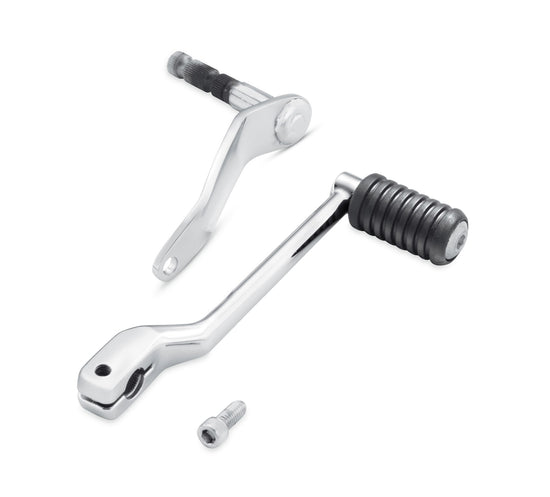

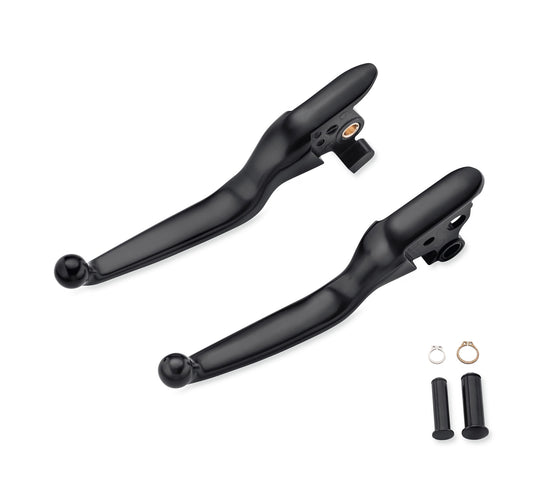

Hand control levers for sale here range from single clutch and brake levers to full kits, heel/toe shift levers and rear brake pedals, at 10% off RRP with free UK delivery available.
Does a hand control lever kit include one lever or two?
The most common ordering mistake on this page starts with the word "kit". A Hand Control Lever Kit is the clutch lever and the front brake lever sold together as a pair, not a single lever with a spare part number attached. 36700065, the Chrome Hand Control Lever Kit for hydraulic-clutch Touring models, is sold as a pair; 45075-07, the older cable-clutch kit for Dyna, Softail and earlier Touring bikes, is the same. 36700305, the Adjustable Hand Control Lever Kit for recent Touring and Trike models, is sold as a pair too, and Harley-Davidson's own listing for it describes maintaining "the adjustability of the original equipment brake lever", which is the part of this job that's actually about reach, not replacement. If you only need to replace one side, say the clutch lever snapped in a low-speed drop, check whether the part you're looking at is a single lever, like 36700125, a standalone clutch lever, before you order. Otherwise you end up with a spare brake lever you never needed.
Cable clutch, hydraulic clutch, Big Twin, Sportster
Touring models changed from a cable-operated clutch to a hydraulic one somewhere between the 2007 and the 2014 model years. Harley-Davidson's own fitment data on kits sold here draws the cable-clutch line at Touring models up to 2007, and the hydraulic-specific kit starts at 2014; the years in between aren't confirmed either way, so check what's actually on the bike instead of assuming. A cable kit will not fit a hydraulic bike, and a hydraulic kit will not fit a cable one. Big Twin and Sportster levers aren't sold under the same part numbers either: most of the kits on this page carry Touring, Softail or Dyna in the fitment data, and 36700052 is stocked separately, specifically for XL models. There is no lever here that fits "all Harleys".
Foot controls are on this page too: shift levers and rear brake pedals
Shift levers, heel/toe shifter kits and rear brake pedals sit under Hand Control Levers as well, and that's worth knowing before you search this page for a clutch or brake lever and come away confused. It isn't a mis-filing to shrug off, either. Heel-and-toe shifting is, as Harley-Davidson describes it on its own advice pages, "almost exclusive to Harley-Davidson motorcycles", and it's only ever fitted to models with footboards, because a footboard gives the rider room to move a boot between two separate levers. 33600001, the Billet Extended Reach Heel/Toe Shift Lever, exists for exactly the case Harley describes: a taller rider, or a bigger boot, needing more reach than the standard-length lever gives, though Harley-Davidson's own fitment data says it isn't compatible with Adversary Touring footboards. The same logic explains why heel/toe kits only turn up on the same Harley-Davidson footboards models and never on a peg-only Sportster. On the brake side, 41600326 and 41600305 are rear brake levers: foot-operated pedals, not hand levers, that carry the same "brake lever" name as the front control but work nothing like it.
What does the MOT check on a hand control lever?
The DVSA's MOT inspection manual for motorcycles is specific about brake controls. A brake lever or pedal "so positioned, bent or shortened that the brake cannot be readily applied" is a Major fault; one that's insecure is Dangerous, the test's most serious category. Pivot wear and abnormal movement in a brake lever are Major faults too. None of that changes depending on whether the lever fitted is a genuine Harley-Davidson part or an aftermarket one.
What it doesn't cover is worth knowing. The MOT test has no scheduled check on a clutch lever at all. The wording above sits in the brakes section of the manual, and the steering section, where a clutch lever would otherwise belong, has nothing on it. This gets muddled online: a UK forum post quoting the "bent or shortened" wording almost word for word applies it to a clutch lever rather than a brake one. The wording is accurate. It's just describing the wrong lever. A tired clutch lever is still worth replacing, but it isn't an MOT item; a brake lever or pedal in the same state is.
What goes wrong, and what else the job needs
A lever is often one of the first things to need replacing after a low-speed drop. The end of a clutch or brake lever is usually the first part to touch tarmac when a bike goes over at a standstill or walking pace, which makes these crash-replacement parts as well as styling upgrades. Fit an aftermarket lever instead of a genuine one and take care around what sits behind it: 71400141 is the clutch lever position sensor switch, a real, separate part that a careless lever swap can damage.
A lever rattling on the bar is more often a worn pivot bushing or a flattened anti-rattle clip than the lever itself. 45423-96, 45423-92 and 45801-04 are the bushings sold on their own, and 12200140 is the anti-rattle ring; several hand levers on this page, including 45016-96, 46243-01 and 45356-07, already include a bushing in the box, so it's worth checking what your lever comes with before buying one separately. A perch, the block the lever pivots in, is sometimes its own part too: 36700254 and 36700317 are satin-black clutch lever perches sold with no lever included.
One more thing worth knowing before choosing a hydraulic clutch kit over a cable one: several Touring owners online describe the hydraulic clutch as a genuinely heavy pull, especially against an older cable bike, and just as many on the same threads say they prefer it. That's a real disagreement between owners, not a fact about the part, so it's worth trying one before committing to a switch. And a lever is sometimes only part of a bigger job. One detailed account of converting a Milwaukee-Eight clutch from hydraulic back to cable names a clutch lever assembly and a hand lever body matching two of our own parts, 45080-08A and 38700-08A. That isn't something to turn into step-by-step instructions here. A clutch conversion is workshop work, not a fitting guide, but it's a fair example of a lever being one part of a bigger changeover rather than a swap on its own.
Everything on this page sits inside the wider Harley-Davidson parts range, so if the lever, pedal or bracket you need isn't here, that's the next place to look.